
I love Glennon, Abby and Amanda. And not necesarily because of the rainbow aspect of it all, but because it is a truth telling space. Although Glennon Doyle’s truth telling career goes a long way back, it seems to me that she has only now found this safe place for truth telling and being real in the presence of people who will not love her and continue to be with her in spite of but because of.
Talking to The One You Feed podcast host, Eric Zimmer, Glennon tells the story of how hungry she was for such a place. Somewhere where she can show us as who she is, share her stories, fears, failing, without fear of judgment and toxic positivity. Glennon tells Eric about, when she became sober, she thought social media was one of these places and she thought she could share honestly what she felt.
So , when I started dripping with children, I had so many kids and I had been sober for I guess 6 years and I had these moments when I remembered why I had been drinking. Oh my gosh! […]
One day I was passing the computer and there was this thing going on on Facebook called The 25 things, so people were just listing 25 quick things about themselves … So I thought, oh, I could do that, I could make a quick list. So I made a list, walked away, came back to the computer like 20 min later and my inbox is smashed with so many emails and my list had been shared so many times. Well, I of course did not read anyone else’s list before I did mine. So, let me give you an example of my number 6, because it’s like etched into my brain forever – I am sweating right now as I am telling you this because it was such an embarassing situation – but my number 6 was: ‘ I am a recovering food, alcohol and drug addict, but I still sometimes miss booze in the same twisted way that you can miss someone who beats you and repeatedly leaves you for dead.‘ Ok, here’s my friend’s Lisa’s number 6: ‘My favorite food is humus.’ Ok, so, that’s how my entire list was, all the numbers. I remember calling my sister and asking how do I get it back and she said you can’t, it’s out there, it’s done. Step away from the computer! And so it was terryfying but listen, the amazing thing was that when I checked my inbox and started reading my emails there were some people that I had known my entire life but who were introducting themselves to me for the first time. They were saying ‘I just read your list, I can’t believe it, my sister is so depressed, I don’t know how to help her.’ […] I don’t know, I was almost pissed because I thought, what are we doing, why are we calling each other friends? We sit together and we are talking about these things that don’t matter, when you’re in so much pain! And I have the same pain! And this has got to be what we are here for! To talk about this stuff
transcribed from podcast
Transitioning to another country, work place, life, really, is so much about the quest for safe spaces and for “our people”. It might seem like this is a “nice to have”, not as important as finding a house, or a school or the perfect grocery store. I would argue that it is precisely the opposite. For me, at least, recognizing the safe space in this new environment and people I can be myself with that won’t abandon me or hurt me is essential.
In his book Safe Passage:how mobility affects people and what international schools cand do about it, Doug Ota writes:
We become more careful when our trusted attachment figures and safe places are not readily available. And our sense of caution isn’t only reflected in the way we act. It’s also reflected in the way we think. We’re less able to explore new ideas and less able to creatively arrive at new solutions.
Doug Ota, Safe Passage:how mobility affects people and what international schools cand do about it, Pg. 13
Over the past months I have been searching. I know the theory: “the more people truly know our story, the safer we are likely to feel with them. The safer we feel with people, the more we are inclined to gradually feel attached to them.” (Doug Ota, Safe Passage:how mobility affects people and what international schools cand do about it, Pg. 45). Practice … feels like constantly walking a tight rope. Practice feels like hit and miss many times. There is no way to understand whether a space or a person is safe except venturing, risking a small part of your story with them, all the time aware that you can be embraced or you can be pushed away. It almost feels like that small part of your story, ripped straight from the tapestry of your heart, pain unavoidable, is that one brave soldier being sent to scout unknown territory to see whether it is populated by friend or foe.
I am lucky, at the end of a hard day, week or month, I come back to a loving family, my forever safe place and my forever people. I do feel however for those of us who don’t have that luxury.
Transition is enriching, it is life altering in a beautiful way. And it is extremely hard as “roots in our hands”, as Doug Ota puts it, we go looking for places to breathe, to put down the mask and risk showing ourselves fully.
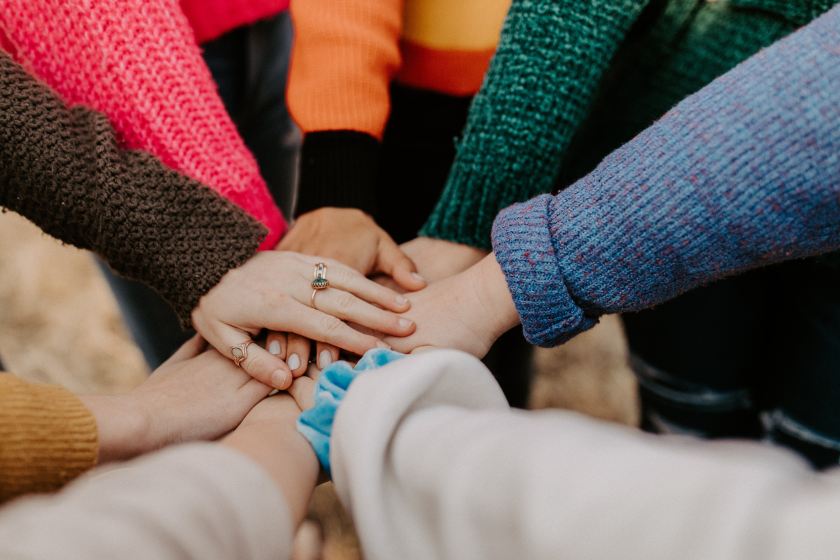
Photo by Hannah Busing on Unsplash
 Connect