
I remember when my son was about two years old. We would go to the park and he would get on the slides. It was very hard for me to watch him stumble going up the ladder and even harder to see him up high on the slide, so close to a dangerous fall and not jump to be up there with him. I can still feel the incredible pull of my motherly instinct to run to him, to help him, to make sure he doesn’t fall. I would literally have to grab on to the bench and whisper to myself: breathe, stay, he will be ok. At one point in my parenting journey, I had understood that if I intervened, I would create a dependency that might have him never be able to stand on his own two feet. Or have fun on slides for that matter.
One of the toughest journeys I was ever on in the past 46 years was watching my brother in his battle with heroin that he eventually lost. Those were 10 years of horrendous turmoil for him, lies, hope against hope, relapses of crushing uncertainty and ultimately of pain that will never go away. I remember looking for some solace in reading about the way that family members should support a drug addict. I didn’t get far into my reading about it because the very first thing I read was the fact that I needed to get out of the way. The most frequent advice I found was that allowing my brother the choice and the dignity of controlling his own journey was the only helpful thing to do. I kept thinking to myself that I cannot do that because I love him too much. That my parents can’t do that because they love him too much or if I were to be more honest, I was worried that if I got out of the way, I wouldn’t be doing “the sisterly thing to do”. And I would always go to the ultimate worry: what if he dies? It turns out that the outcome was in nobody’s control but my brother’s. Maybe not even in his at that point. What all the books I read advised was that, when we don’t let people ride their choices all the way to the end, we stunt them. That when we put ourselves in the way of whatever is to come for them (basically assuming that we know better, that we see things they don’t, that we can do better), we do not help, that is such a false assumption. We are in fact a barrier to their growth, to their making of their own choice and living with the consequences, to their learning about and understanding of themselves.
A while ago I watched a movie that I did not particularly enjoy but that showed me one thing that I probably would always remember. Nyad is the story of a swimmer with a dream that never died. Story aside, as she swims in very troubled waters, her team is on a boat next to her, and in the boat, her team is lead by her soulmate, who loves her beyond her own understanding, and if I’m honest beyond mine. There is one rule that the soulmate must follow: she can shout things from the sidelines, she can provide water and food, she can offer her opinion on things, but she cannot intervene in the swimming. She can only intervene when the matters become life and death. If Nyad is as much as touched by someone on the boat, she is disqualified, her journey is over. Because that journey will no longer be hers. As I watched the movie, I found myself wondering who has it harder: Nyad, who is in the water facing poisonous jellyfish, cold and exhaustion, or her soulmate, who is in the boat, watching all of this, and not able to do anything other than just hold space, help nourish and keep vigil.
There is nothing simple about being on the sidelines. When we see our loved ones struggling, there is a breaking in ourselves as well, but there is no true love without respect, without the trust that the person we cannot live without is able to navigate whatever the moment brings. This is not about “they can do it on their own”. This is about “they have to do it on their own, even if they fail.”
Keeping ourselves on the sidelines means daring to allow the other person to have their own journey, to make their own choices, to not have to think about pleasing us in all of the hardship that they are going through. Remaining on the sidelines, eyes peeled on our person, their struggle and being present there with them whispers to a person in turmoil you can do it on your own, but you are not alone. This is your job to do and I am here holding space for you. I respect you enough to trust you and I will not leave you, whether you are on your knees or on the peak of the mountain.
In her own simple and beautifully crafted way, nature speaks to us so much about the value of struggle. A caterpillar struggles so mightily to break the cocoon that’s been home for a long time because she senses that there is something more out there. Because she can no longer be just a caterpillar. It is nature that she evolves. If her crisalide is broken from outside before the caterpillar manages to get out of it herself, the little creature will never fly. Her wings will never be strong enough – it is the struggle to escape that strengthens her wings. In parenting, in love, or in life in general, sitting on the sidelines is excruciatingly hard. And still, taking the easy way out would be to barge into someone else’s life and choices, take over, demand control, and make them dependent on us and our choices. May we all have the courage to breathe and remain seated, fists clenched and jaws locked. May we all hold the others in such high regard as to wait to be asked for help and love them through the consequences of never actually asking for it and failing.
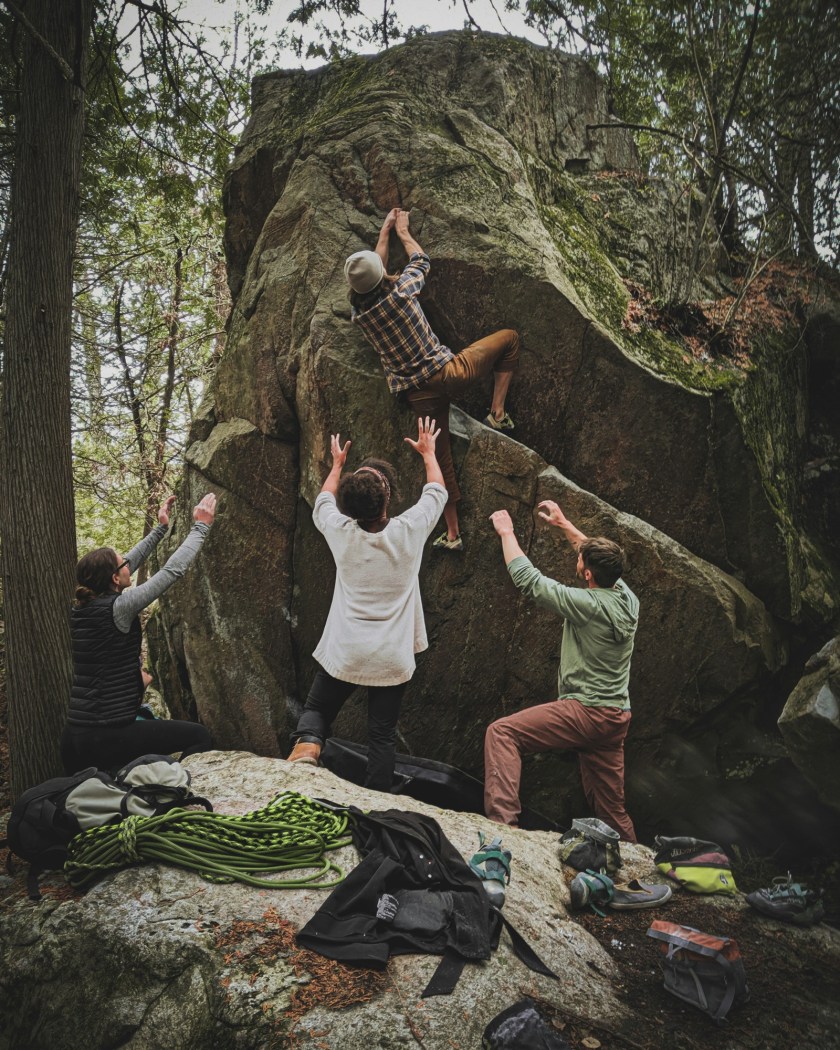
Photo Mark McGregor on Unsplash
 Connect