

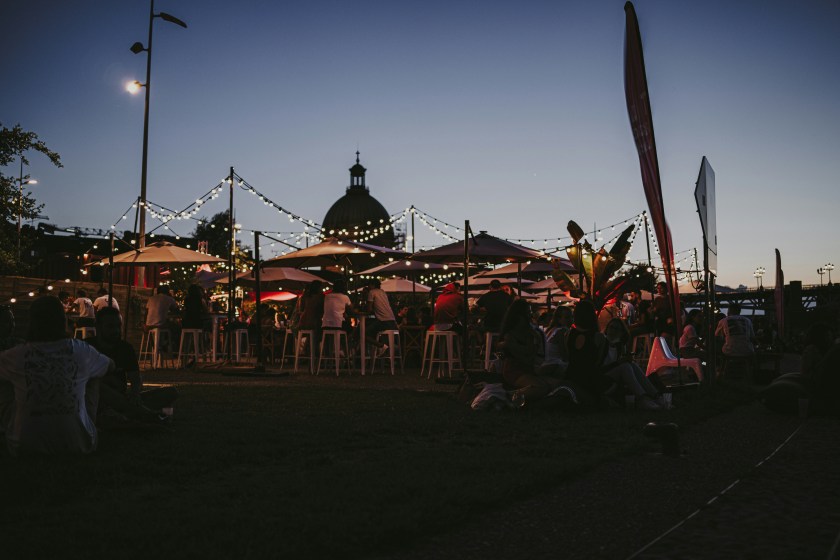
The other morning I was walking my dogs in the wee hours of the morning on the empty but stunning park alleys of Copenhagen and I woke up from the podcast I was listening to enough to notice there were yellow leaves on the ground. Fall is coming, I found myself thinking. And with that, came the realization that I had been here for over one year. I threw my memory back trying to encompass the entire last year, the rollercoaster and the peace of it, the new and the old, the change and the sameness. What a year!
And because nothing seems to have a purpose unless we find the answer to “what is this here to teach me” about it, I reflected for a bit on the few but powerful lessons my first year in Denmark, the land of hygge and happy, taught me.
Balancing opposing realities at the same time is a superpower.
The two of us left the country of our birth not looking back. By the time we got into our car with the few belongings we were driving to Denmark and our two dogs, we felt like we had tried everything in our power to at least fit in where we were born. Belonging had gotten out of the question long before. It simply had not worked out and we decided to cut ties. And as the year progressed we realized that this was a misguided goal. Our parents and friends remained behind and memories were built back there, good or bad. And we found ourselves in the confusing land of missing a “home” we did not miss. Almost all around us we heard from colleagues and acquaintances who could not wait for winter break to go “home” and we knew we were “home”. Little by little we learned to hold both realities: that we do not miss the country we were born in and that it does not feel like home and at the same time that there are moments and people who keep us looking back with nostalgia.
Probably the most difficult aspect of our first year in Denmark has been the fact that, even though we share the same physical space, our son calls a completely different place “home”. His experience of the country we left felt completely different to him, the choice to leave was not his and there isn’t the same desire in him as it is in us to grow roots here. Little by little the push an pull of trying to sit only on one side of this subsided and we just let it be. For me, the umbilical chord became slightly thinner in Copenhagen.
This too shall pass.
Much like the winds and rains of Denmark, the past year surprised me with moments of intense frustration, followed by sunny days when I thought life could not get any better, walking in crisp air, in wonderful green pastures. I found myself on a continuous rollercoaster of wanting to catch the good times in a jar and preserve them, while at the same time chasing away the bad ones wanting to make sure they don’t return. Fortunately, a person I trust with my thoughts and feelings reminded me that the only reality that matches every situation we find ourselves in is this too shall pass. So I stuck the post-it on my screen and started practicing the art of impermanence.
The measure of happiness is relationships.
So much ink has gone into explaining the Danish art of happiness and I still think not enough has been said about the one thing that lies at the foundation of it. Coming from countries of the once labeled “third world” of course we were mesmerised by infrastructure, plenty, comfort, logistics. But when the shine wears away and you get used to everything, the secret to Danish happiness stands out: cultivating relationships. Not a surprising finding if you think about the fact that this is what the prestigious and long (longest?) Harvard Study on Human Happiness has found as well – that our happiness and even our longevity lie in the quality of our relationships.
We have a lot to learn from the Danes. From the way they come together in parks, devices aside, they talk to each other, celebrate one another, make food together and drink in each other’s honor, to the way that create these experiences intentionally, every chance they get. Colleagues at work shared with me celebrating with their building neighbours a certain number of years living in the same space, or sitting at a long, long table in the middle of the street eating together with strangers.
Every morning I bike by one of the more important train stations which is close to the school. There is a man who looks quite dishevelled and is probably homeless. He sits in front of one of the more popular groceries stores, smokes or has a beer. Every day, every single day, someone stops to talk to him. And it seems it is the only thing he wants – he is the initiator: he offers a piece of information or asks a question. I noticed teenagers, ladies, gentlemen, young, old, stopping to chat with him. When was the last time you looked a homeless person in the eye, let alone have a conversation with them. To me this shows such respect for humanity that it paints my Danish experience in a completely special light.
Every sunset is a reset.
If you had asked me five years ago where I would be a decade down the line, I would have sworn that I would still be working for what was my beloved school in Bucharest. I had no doubts. And the sun set on that and broke my heart. I am still not able to talk about it without my jaw tightening. A sunset …
One of the first drawings I collected from our son and carried with me through the years has been one where he drew a sunset and wrote: every sunset is a reset. We still have it in our kitchen, here with us. It is hard to realize it in the moment, probably because of pain and anger and frustration. But slowly, as the sun goes down on a person we used to be or an experience we had, we reset and begin anew.
I don’t know if I would have paid attention to Denmark, had I not closed a chapter as important as a job I held for over two decades. But I am certainly glad I did. One year down the line, I find myself saying so often: I have found nothing in this country I did not like. And that is quite amazing!
Photo by Maëva Vigier on Unsplash
 Connect