

Diary of a Romanian Racist in Transition. Episode 3
(this is a translation from Romanian, partially with AI support)
(Warning: this episode contains pejorative and violent language directed at the Roma ethnicity.)
The other day, I was talking with someone very close to me about why I am trying so hard not to use the word “țigan” when referring to a person of Roma ethnicity. Her reply came quickly and, to be honest, I was expecting it: but that’s what they call themselves among each other, țigani. And that’s what they prefer. Isnt’ it?
I had just watched the first episode of the show Eu sunt Actrița Principală (only in Romanian), hosted by Mihaela Drăgan and Zita Moldovan, and in their conversation with Roma director Andrei Șerban, I heard him dismantle the myth that Roma people prefer the word “țigan.” I had heard this only a day before, and yet I couldn’t respond to the person who had asked me, even though she is one of the closest people in my life, someone with whom I discuss everything.
Systemic racism is so dangerous because it operates deep within us, at the level of rooted beliefs, “default” behaviors, and actions we take without thinking. Dr. Brené Brown tells us very clearly that we must choose between courage and comfort, because they cannot coexist. In my conversation, I chose comfort, because it is hardest to overturn myths and stereotypes when they appear in conversations with those you love. This shows me how much further I still have to go on the path I have chosen: a path toward antiracism. And I want to be clear: my friend is one of those rare people with a deep thirst for knowledge and a mind open to change at all times. The barrier was in me. Exclusively.
If I had been more prepared, I would have told my friend that it is one thing for Roma people to call each other “țigani,” and another for members of the majority to call them that. When two Roma call each other “țigani,” they are acknowledging between themselves the marginalization, oppression, and struggle whose consequences they both carry. When a non-Roma person calls someone “țigan,” they demean them. Regardless of what we Romanians say about our intentions, history contradicts us. Roma people were enslaved for five hundred of the last seven hundred years. They have always been pushed to the margins of society and continue to be. The Romanian language continues to throw at them expressions that portray them as subhuman, and discrimination is flourishing even in 2025. We cannot consider that the term “țigan,” spoken by a non-Roma person, is anything but an insult.
But don’t take my word for it. Here are a few sources you can consult (and in a future episode I will explain why it is our responsibility, as racists in transition, to educate ourselves – and not the responsibility of the victims of racism to educate us):
In the previous episode, I wrote about the origin of the word “țigan” and its translation as “those who do not touch us / the untouchables” (DoR, 2021). The dehumanization of entire populations always begins in language. The reason is as simple as it is macabre: human beings are not instinctively wired to attack one another violently. We are neurobiologically built for connection, and in order to kill one another, we must first reach the conclusion that those we attack are not fully human. (Brown, 2017) This is where language intervenes: the Nazis called Jews rats, we, the majority, call Roma people “țigani” or “crows.” In this way, our brains allow us to cross barriers we would not cross with our fellow humans. A “țigan” is someone “untouchable”; a “crow” is not human; therefore, we can behave toward them in degrading and violent ways. “They’re not like us! A țigan is always a țigan!”
When a majority member or non-Roma person uses the term “țigan,” they assign a label of inferiority to the person being addressed. In Episode 2 of Obiceiul Pământului (in Romanian) you will hear Delia Grigore. A Romani writer, researcher, and cultural activist, Delia Grigore holds a degree in philology and a PhD in visual arts, specializing in ethnography–ethnology. President of the Association “Amare Rromentza” Roma Center, she has nearly 30 years of civic and cultural activity. A lecturer at the University of Bucharest, she coordinates the Romani Language and Literature Program. She is a member of the “Barvalipe” Academy in Berlin and of the “Costache Negri” Writers’ Society. Recipient of numerous awards, in 2024 she won the grand prize of the International “Amico Rom” Competition. Even Delia expresses surprise when discovering the image of Roma people in folk tales. There, the țigan, the țiganca are deceitful, thieves, antiheroes, pretending to be heroes but not truly so, while the real hero is the white prince (Făt-Frumos, as he is called in Romanian). (DoR, 2021) In all her work (and if we are to look at her achievements, we understand it has been extensive), she has not found a single positive quality associated with Roma people. How could we then claim that when we, non-Roma, racists from father to son, and mother to daughter, oppressors of the Roma for five centuries, call a Roma fellow human “țigan,” we do so with a positive or even neutral connotation? The latter have never existed, unfortunately, in the Romanian collective understanding.
During the enslavement of Roma people (1385–1856), the term “țigan” referred to property, not a person. In historical archives, “settlements” of țigani are listed and sold alongside carpets, pianos, or livestock. They are donated, sold, inherited, just as we today handle our houses, jewelry, or… a wardrobe. Therefore, we cannot claim that when a non-Roma person uses the word “țigan,” it symbolizes anything other than humiliation. (DoR, 2021)
In recent months, I have learned enormously from Adrian Nicolae Furtună, a Roma sociologist. He speaks about how, when someone on the street calls him “țigan,” he knows it is meant to remind him of a “lower” status. Other Roma men and women say they themselves use the word “țigan(că)” because “they’ve heard it all their lives” and it has become normalized, or that they use it intentionally and strive to live lives that demonstrate that being “țigan” also means being talented, hardworking, upright. What pressure!
One of the aspects that overwhelmed me when I began listening to the real stories of Roma people and turned my face away from stereotypes and stories told by Romanians about them is the idea that there are no reparative actions in this world capable of bringing them to where it would be equitable for them to be today. And through further reading, that continued to be revealed. As a nation, however, we are very farfrom almost any type of reparative action. Therefore, one very simple act for us, but meaningful for our Roma fellow citizens, would be to stop calling them “țigani” and instead call them Roma. I invite you to notice what happens inside you when you use each of these terms. Notice how you look at the person in front of you, of Roma ethnicity, in each of these two situations. Your own body will educate you.
This “simple” change would be a signal from us toward recognizing the oppression they have endured and continue to endure, and a hand extended toward reconciliation. The only actions that are truly healing.
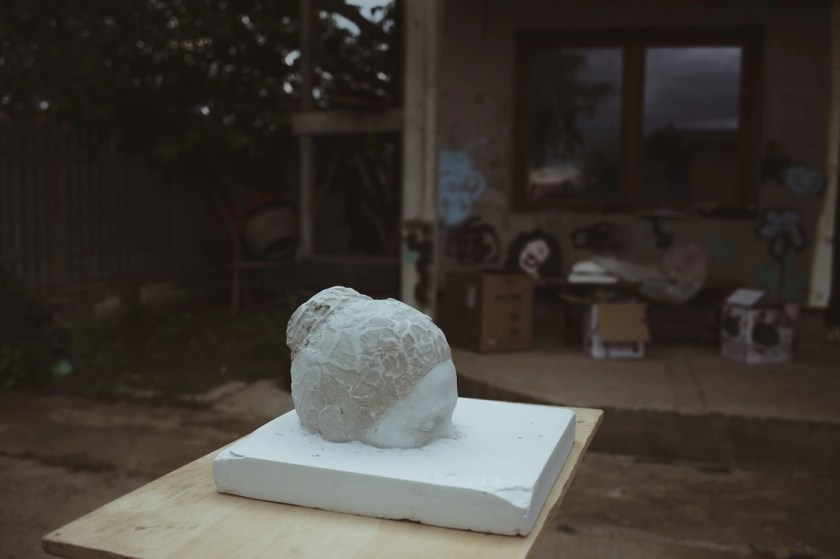
Photo: “The Silent Scream” – Mihaela Cîmpeanu, Roma artist
Resources
Brown, B. (2017). Braving the Wilderness: The Quest for True Belonging and the Courage to Stand Alone. Random House.
Obiceiul Pământului. (2021, September 20). Episode 2: 500 Years [Podcast]. DoR. https://www.dor.ro/obiceiul-pamantului-2-500-de-ani/
 Connect