


Diary of a Romanian Rasist in Transition. Episode 4
(this is a translation from Romanian, partially with AI support)
(Warning: this episode contains pejorative and violent language directed at the Roma ethnicity.)
I grew up and was educated with the certainty that “race” is a truth. The concept of race was not even explained. It existed in books, in speech, in our collective mindset as a given. No one questioned it. At some point, at the beginning of my journey toward antiracism, I came across an interesting idea: that race (like aspects of gender, neurotypicality, etc.) is a social construct. Essentially, we, the “white race,” the “majority,” were uncomfortable with the lack of scientific evidence proving that we are “the most,” so we produced it.
In her doctoral dissertation at Maynooth University in Ireland, Dr. Lilian Nwanze Akobo provides details about Critical Race Theory (CRT). Since these details were new to me, I thought it might be useful to include them in this journal. Who knows who else might benefit from knowing that race is an invented concept, created to demonstrate that white supremacy is grounded in science rather than in power, discrimination, and privilege.
In her work, Dr. Nwanze challenges the idea that race is determined by biological reality or genetic parameters, showing that it is, in fact, a social construct that society “invents, manipulates, or withdraws” when convenient. She also discusses “differential racialization,” referring to the way the dominant society racializes different minority groups at different times, often in response to economic or labor market needs. (Nwanze, L. N., 2024) When I read this, I must admit, my mind went to the way Roma people are viewed today, the opportunities that are (not) offered to them, and the fact that, apart from a few courageous activists, hardly anyone is fighting to bring them from the margins (where they have always been pushed) into the city, to be included (Not integrated! The difference matters.)
Critical Race Theory posits that racism is not an isolated, unusual, aberrant, or individualized act, but a normal phenomenon woven into the very structure of society. It is the ordinary way in which people of minority ethnic backgrounds experience the world. For this reason, it is difficult to combat, because only the most blatant and extreme forms of racism are recognized and addressed by society. If racism were an isolated accident (the traditional perspective), it would be like a car occasionally getting a flat tire. The perspective of Critical Race Theory, however, sees racism as typical: as if the car (society) had been intentionally designed and built from the very beginning with uneven wheels, ensuring that certain groups always move faster and more easily, while others constantly face additional effort, which outsiders perceive as “normal” or the result of poor maintenance.
Before you rush to contradict this, let’s look at a bit of history. The timeline of the social construction and function of race unfolded across several eras, each using different factors (religious, economic, scientific) to justify oppression and maintain social hierarchy. To summarize briefly, I created the image below inspired by Dr. Nwanze’s work, together with my partners, Notebook LLM and Canva.
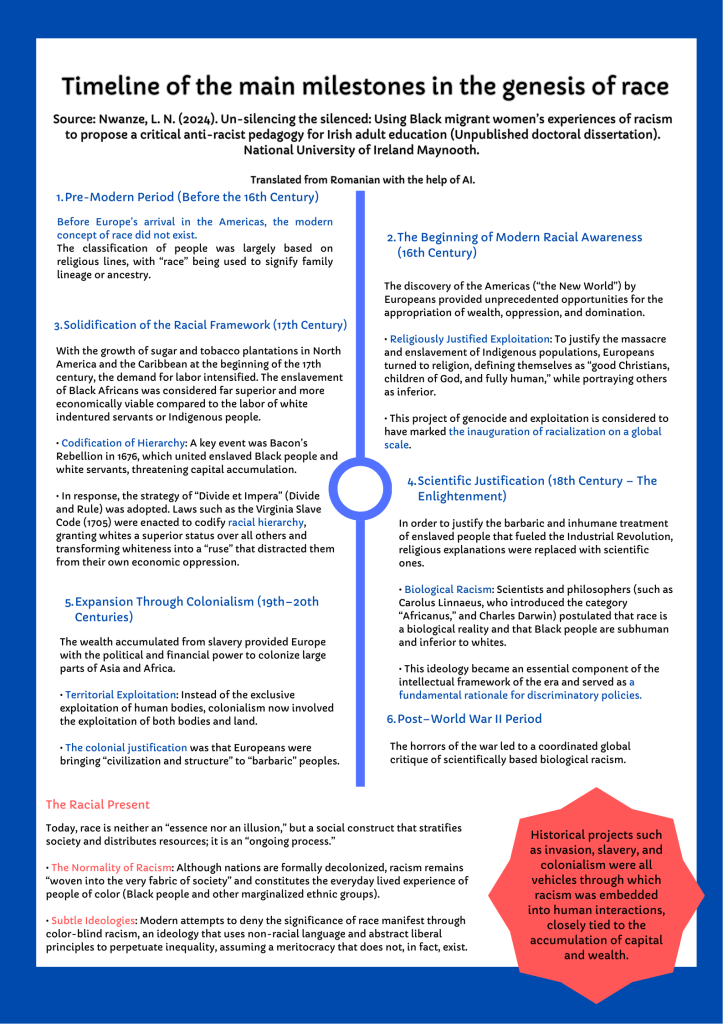
And before you say that this was “back then,” that things are no longer like this, let’s pause and think calmly for a moment:
- The idea of racial hierarchy is evident even in the very concept of “integration.” We, the white race, the superior ones, seek to “train” those who are different (“people of color” / the Roma) to become as much “like us” as possible. No, because we can never truly place them on equal footing, since… “a gypsy is always a gypsy!” Right?
- From the time of Roma slavery until today, there has been this idea that the intervention of the white race upon “barbaric” peoples (in other words, different ones) was meant to develop them, to educate them. This concept lay, for example, at the root of the prohibition in many European states against allowing nomadic Roma groups to settle there. Because we, the white race, know better, are more educated, more civilized, we forced them to abandon their caravans and move into houses. We did not ask why they live in caravans, what the meaning of their colors is, what traditions they have and what those traditions signify. We simply knew better, didn’t we?
- At the root of the dehumanization that led to so many tragedies lies the ideology of biological racism. Today we (still) point the finger at the Nazis, who seem to be the parents of eugenics (though they were only its disciples), and we imagine we are very far removed. Every time we assume that a Roma person is dirty, uneducated, a thief; when we call them a “crow”; when we refuse to let them into our homes; when we shout “hey, gypsy!” – reducing a fellow human being (different, though they may be) to a race we recognize as inferior, we are acting from this root of biological racism.
Okay, I admit it. My first reaction was also: “Oh, come on, it’s not my fault! That’s how I was raised and taught! What am I supposed to do now?”
This is the great trap: to believe that we can do nothing. The “simple” act of wanting to know more, to understand, of agreeing to endure the discomfort that arises between the racism we are steeped in and historical truth, of trying again and again to do things differently, a little bit each day—all of these are huge steps toward change.
As Margaret Mead wisely said:
“Never doubt that a small group of thoughtful, committed people can change the world. Indeed, it is the only thing that ever has.” Wait, have I said this before? It must be important if I felt like saying it again so I will just leave it here
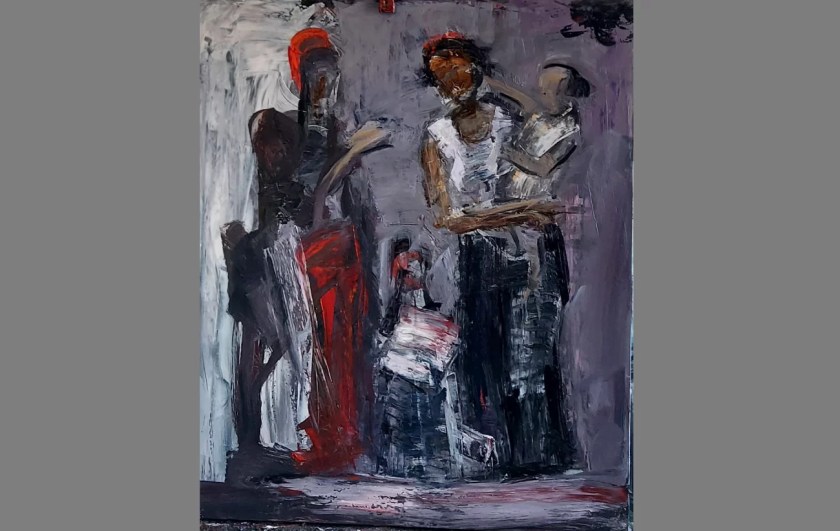
Image: Portraits of Roma women and men by Eugen Raportoru, displayed in London.
 Connect