

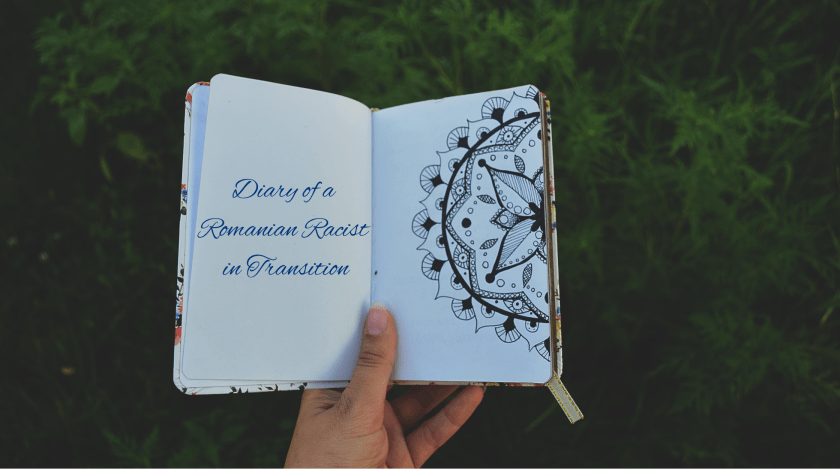
Diary of a Romanian Racist in Transition. Episode 5
(this is a translation from Romanian, partially with AI support)
I met A. when I was living in a neighborhood in Sector 3 of Bucharest. She sold flowers on the ground floor of the building where I lived and, most of the time, she was running from the local police who would confiscate her flowers and issue countless fines she could not pay. She wasn’t the only flower seller in the area, but she was the only one who called me “princess” and offered me a flower when she saw me. And who, like me, was pregnant.
Beyond the differences in ethnicity, skin color, and occupation, there were major differences that at the time I did not know. A. lived in Ferentari, in the hell that not many manage to escape. Yet she was happy with the “house” she lived in (a mix of cement, sheet metal, and whatever materials she and her family had found). At one point she had lived under a bridge, so now she considered that “it’s better.”
We both gave birth in the same month. The universe has fascinating ways of showing us that we are all human. The same. Well, as a species. Privilege does not enter into this discussion.
For a while, A. stopped coming. Her sister or grandmother would come instead, and I would learn bits of news about her. That’s how I found out that this baby was not her first. The first had died at birth because the doctors had not given her proper attention, because she was a “filthy gypsy” who “should have washed before entering the wards”. Now she was fighting again: she had given birth to a boy, as had I, and she was happy he was healthy and… alive.
Far too soon, A. returned to selling flowers. I became “princess” again, started receiving flowers again, and we began talking about our children. Each of us carried despair in her soul: me from postpartum depression, her from the impossibility of clothing and feeding her child. Privilege is visible even in the burdens we carry.
Slowly, I began offering her various things. Disposable diapers, clothes, food. For a while. Then I forgot. For me it was “charity”; for A. it was a step beyond survival, a day with better food, a situation where she had medicine for her child. I am sure she did not forget about me. Poverty does not allow you to forget.
Soon after, A. was pregnant again. This time she gave birth to a girl. I divorced, moved, and lost touch, until one day she called me crying that her children were sick and she had nothing to feed them.
I would love to tell you that I was happy to hear her, that I immediately rushed to help her. How I wish!
If you had met me, nothing in my appearance or behavior would have told you that I was racist. On the contrary. I went to church, gave alms, helped anyone who asked. But of course, none of that has anything to do with antiracism.
The feeling of indignation that A. had my phone number (which was public on a consulting website), the fact that I scolded her for calling me, that I hung up – this is where the seeds of racism planted in me long ago blossomed. You might say it could have been anyone, that I didn’t know her and would have reacted the same way. But the truth is that when someone asks for our help, it matters whether they are “majority” or Roma. If I had stopped for even a second to think about how a woman without education or internet had managed to find my last name and locate me, perhaps I would have guessed the desperation. But racist indignation did not allow me.
In my defense, I must say that I called her back. I take this as a sign that I was not completely lost in the abyss of discrimination. From that moment on, for years, I tried to help A. as I could. With clothes, food, a Christmas tree, school supplies, and so on.
Again, I would love to tell you that I did it as for an equal, as for a friend, or at least an acquaintance. I can tell you that I tried. For example, because she called me Mrs. Cătălina, I called her Mrs. A., and that never changed. But inside… I was superior. I felt it instinctively, and it bothered me at the same time.
I forced myself to look her in the eye, to listen to her problems as I would a friend’s, to trust her, to listen to her decisions and respect them. To believe she saw in me more than a source of money, food, and school supplies. But… I failed.
When the children were in the eighth grade, four years ago, I ended the relationship abruptly and completely.
I had gone to them with Christmas gifts, and that same evening my family went to see a movie at a mall in Bucharest. There we ran into A.’s children. They had come to buy gifts. At first, I was happy to see them – these were children I had known since before they were born. Then racism and “superiority-ism” triumphed.
I thought and said, in front of my own son: “Look at that! We bring them food and clothes, and they’re buying Christmas presents at the mall.” I sent A. a message reminding her that at some point I had asked her not to lie to me because she won’t see me anymore(I know how that sounds, I know!) and I blocked her number. She had managed to reply that she understood, to forgive her, that her sister had given the children money and she hadn’t known, and that she cared about me.
It has been four years since then. I have not forgotten A. But something deep inside me would not let me stay in contact with her. What? “A gypsy is always a gypsy.” “A gypsy will trick you.” “Gypsies are thieves and cunning.”
Racism is present in us even when (or perhaps especially when) we do good. I never called A. to ask how she was, as I would a friend. I never invited her for coffee. I never told her anything about myself beyond what she happened to know. I did not trust her enough to tell her that my life partner is a woman – even though she knew my partner. I did not let my child play with her son. I judged every small sign of progress I saw in their home in Ferentari, as if abject poverty were a mandatory condition for someone to deserve help. As if anyone must deserve help.
This morning, four years after my last message, I wrote to A. I asked her to forgive me for not being able to move past what happened and invited her for coffee.
I would like to tell you that I am waiting for her reply because I missed a friend. Yes, that is true. A little true. What is more true is that, with time, I have concluded that I was too harsh, that I want to erase a stain from the ledger of my deeds, and that I feel it as proof of generosity: look at the Romanian woman trying to see the gypsy woman as her equal. Wow, what evolution!
I wrote this story so I could read it. If I had not started writing it, perhaps I would not have been able to send A. that message this morning. But I also wrote this story in the hope that someone, somewhere, understands that the road toward antiracism is not linear. It has ups and downs, and deep descents that look like climbs. We stumble, we curse, we promise we won’t do it again, and yet we do. It is a winding road, unfortunately against the grain of our upbringing in a deeply racist, homophobic, and xenophobic society, a road no one guides you on, and one where, if you set out, you risk losing many of those you love.
But it is one of the most important roads we have to walk if we truly want to reach the core of our humanity.
Bonus: The Giuvlipen Theatre created this remarkable performance about Ferentari and discrimination. I invite you—no, I urge you—to watch it. It is in Romanian but you might be able to add English subtitles in YouTube.
 Connect