

Diary of a Romanian Racist in Transition. Episode 7
(this is a translation from Romanian, partially with AI support)
I was brought up with the conviction that no matter how well you get along with a Roma person, in the end “they’ll trick you.” That “a gypsy is always a gypsy.” This idea, repeated around me from early childhood, planted deep within me a lack of trust toward Roma people, something I now don’t quite know what to do with. I wish I could erase it with an eraser. But beliefs planted in childhood, when our minds and hearts are like sponges, take root in our souls and those deep roots are hard to pull out. All I can do is acknowledge that these beliefs exist within me, not ignore them, and choose to go against the current I feel inside.
The reality is that what I described above is only the tip of the iceberg that is anti-Roma racism in Romania. Its foundation is the slavery in which the Roma population of the Romanian Principalities was chained for five centuries. In order to “own” others, you must dehumanize them, convince yourself that they are not “people like you.” Thus, beginning even with the name given to them—“țigani” (from athinganoi – untouchable, to be avoided)—the humanity of Roma people was denied; they were considered inferior, foreign, pagan, and therefore “fit to be owned” (Obiceiul Pământului, Ep. 1).
The narratives of the time, propagated especially by the Church (one of the largest slave owners in Romania, by the way), claimed that slavery was actually a “mercy” shown by the state, the Church, and individual slave owners toward this “wild,” uneducated “species,” who should be grateful for their masters. Because, of course, only white, Christian, majority education, morality, and religion were—and are—“fundamental,” right?
Delia Grigore, founder of the Virtual Museum of the Roma and leader of the Roma Center Association Amare Rromentza, links the emergence of stereotypes to the fairy tales and stories Romanian children have always heard. In these stories, the “gypsy man” and “gypsy woman” are portrayed as deceitful, thieves, always anti-heroes. In the tales of the renowned Romanian story writer, Ion Creangă, Roma people are portrayed as lazy: they sing while the peasant works.
And the stereotypes that depict Roma people as dangerous and thieving also have their roots in slavery. The escape of Roma who could no longer endure enslavement was portrayed as wild and antisocial behavior. Runaway slaves were hunted, punished with the whip, chained, fitted with horns around their necks and legs precisely to force them not to run again and to set an example for others who might harbor such thoughts. This mechanism reinforced the image of Roma as a marginal and dangerous social category (Obiceiul Pământului, Ep. 1).
We do not find many details about the inhumane treatments to which Roma slaves were subjected (were they running from comfort?) or about the absolutely horrific manner in which young women and girls were raped and forced into marriage to increase the number of slaves. Of course, Roma ran away simply because “that’s how they are”… .
Though painful, it would be better if all this remained in the past. But stereotypes have contemporary manifestations that continue to wound an entire ethnic group. Ideas about theft, cunningness, and inferiority have been transmitted from generation to generation and continue to marginalize and separate anyone who has even a trace of Roma blood in their veins.
“Be good or the gypsies will steal you” is the phrase that gives the title to Gelu Duminică’s recent book and exemplifies a warning spoken (half jokingly, half seriously), to mischievous children. Let us think for a moment about what this “innocent” saying plants in a child’s mind and what will surface when that child later encounters a… “gypsy.”
In the view of many, Roma people do not even deserve to be commemorated as victims of the Holocaust. Invoking cunning, theft, and sub-“normal” standards of living has supposedly justified ethnic cleansing, which was in fact the removal of “violent elements.”
Dr. Madeleine Potter, a Roma scholar living in Scotland and teaching at the University of Edinburgh, recounts in her book The Roma: A Travelling History how, when she enters a store, she is followed; how she is not believed when she says she holds a doctorate and is asked where she stole it from; how she is most frequently stopped for checks; or how she receives “compliments” such as: “Oh, you’re one of the good ones.”
Some of the most popular characters created by the Romanian Media Pro network are “State de România” and “Flăcărica.” We all laugh when established Romanian actors bring these characters to life. If we tried to look beyond this thin layer of humor, we would see that what animates these characters is a bundle of stereotypes that are difficult to combat when reinforced through humor, prime-time representation, and repetition: State is a criminal, deceitful, unscrupulous; families are uneducated, dangerous; there is violence, theft, murder. This is the world of most Roma characters portrayed (and played, by the way, by non-Roma actors). The only one among them who is a doctor is the exception to the rule. But the rule exists, and it is confirmed daily by the stereotypes that dominate our collective mindset.
At the beginning of the 2020s, a survey clearly showed that 72% of Romanians do not trust people of Roma ethnicity. We are not speaking here about individuals proven to have committed illegal acts, who have documented criminal histories, or who have attacked us. Their only “offense” is being Roma. Only 11% of respondents in the same survey said they would want to marry into a Roma family. Obiceiul Pământului tells many stories about the difficulty Roma individuals face in meeting the family of a non-Roma partner, or about Roma real estate agents considering abandoning their chosen careers because they can no longer endure the question: “But are there gypsies in the area?” (Obiceiul Pământului, Ep. 5).
It is hard, very hard indeed, to remove racism planted within us when we were still small children. But we can begin by becoming aware of it and how it manifests. The moment we become conscious of facts, it becomes much harder to persist in denial. The most accessible and also very complicated step is to pay attention to the language we use. Dehumanization always begins there: what we say, hear, reinforce, and spread.
If we can go one step further, when we catch ourselves expressing stereotypical beliefs, we might ask: How do I know this? What do I mean by this? Or: What am I really saying through this?
Escaping racism is a difficult climb, with falls, rises, relapses, and continual rising again. The important thing is not to become discouraged. To begin again at every moment. Beginning by beginning, at some point we will look back and today’s stereotypes will feel a little more foreign.
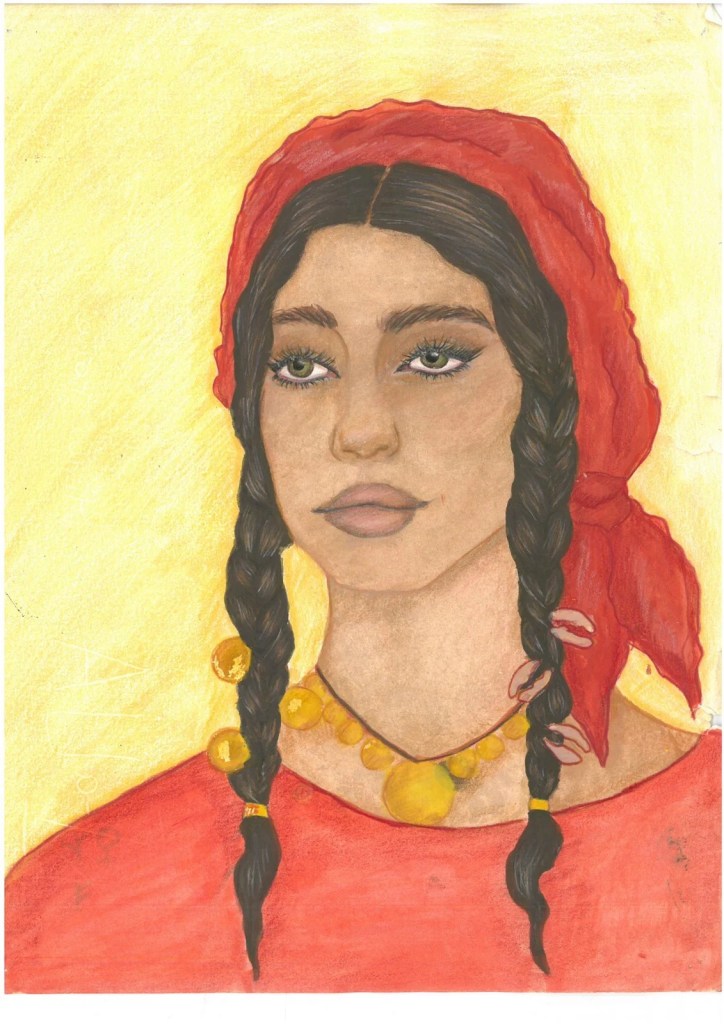
Photograph: Mihai Ilaria at the International Virtual Museum of Roma Art.
 Connect